Alright, let’s dive into the world of GPT prompts for bloggers, specifically focusing on how to craft long, SEO-friendly articles without relying on images. This is a fantastic strategy to capture organic search traffic, as Google often favors comprehensive, in-depth content. We’ll explore various prompt categories and how to leverage them for maximum impact, all in a casual, blogger-friendly tone.
The Power of Long-Form Content for SEO (Even Without Images)
Before we get into the nitty-gritty of prompts, let’s quickly chat about why long-form articles, even without images, are such a big deal for SEO. Think of it this way: when someone searches for something on Google, they’re usually looking for thorough, helpful information. A short, superficial article might give them a quick answer, but a long, detailed one can become their go-to resource.
Here’s why Google loves longer content:
ChatGPT Prompts for Bloggers (Ideas, Outlines, SEO & More)
Deeper Dive into Topics: More words mean you can cover a topic from all angles, answering a multitude of questions a user might have. This signals to Google that your content is highly relevant and authoritative.
More Keyword Opportunities: Naturally, a longer article allows you to weave in more related keywords, long-tail keywords, and semantically related terms. This expands your reach and helps you rank for a wider range of searches.
Increased Dwell Time: When readers spend more time on your page, it tells Google that your content is engaging and valuable. This “dwell time” is a strong ranking signal.
Authority and Expertise: Long, well-researched articles showcase your expertise and establish you as an authority in your niche. Google prioritizes content from authoritative sources, especially with its E-E-A-T (Experience, Expertise, Authoritativeness, Trustworthiness) guidelines.
Backlink Magnet: High-quality, comprehensive content is naturally more shareable and linkable. Other websites and bloggers are more likely to link to a thorough resource, and backlinks are still a cornerstone of strong SEO.
So, while images definitely have their place, don’t underestimate the power of pure, unadulterated text when it comes to ranking in the search engines. Your goal is to be the ultimate answer to your readers’ questions, and GPT can be your secret weapon in achieving that.
Crafting the Perfect Prompt: The Basics
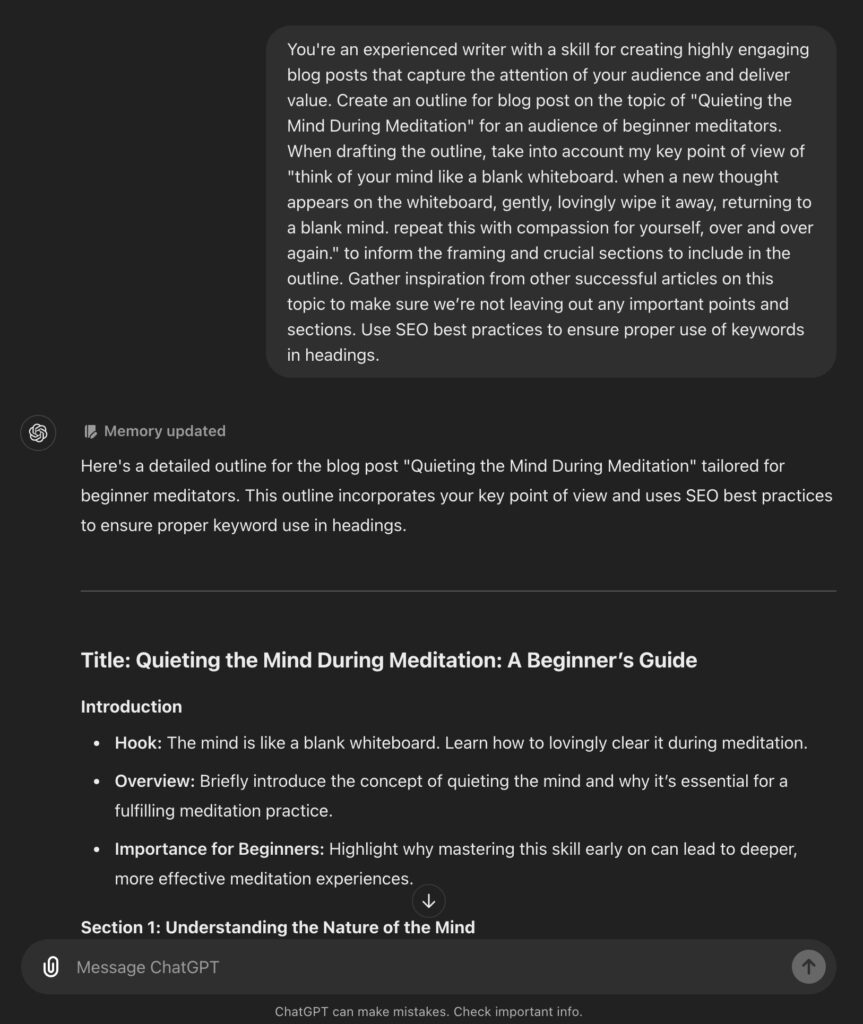
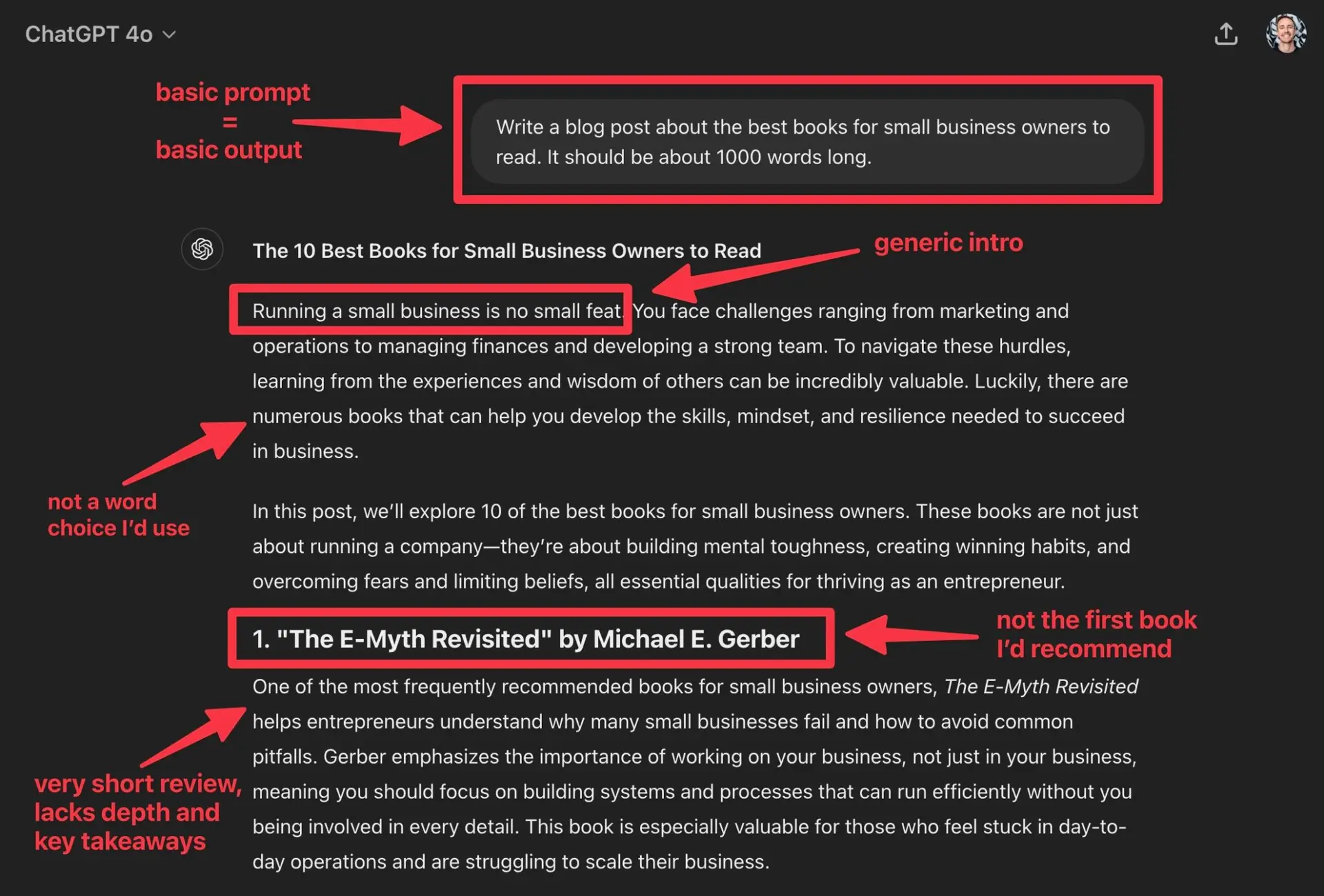
When you’re talking to a GPT model, think of it like talking to a super-smart but sometimes literal intern. The more specific and detailed you are, the better the output will be. Don’t just say “write a blog post.” Instead, give it context, define your audience, specify the tone, and outline your goals.
+ Best ChatGPT Prompts for Bloggers: Free Templates
Here are the key elements for a strong GPT prompt for blogging:
Role/Persona: Tell the AI who it should “be.” (e.g., “Act as a seasoned SEO expert,” “You are a friendly travel blogger.”)
Task: Clearly state what you want it to do. (e.g., “Write a comprehensive article,” “Generate an outline.”)
Topic/Keyword: Be very precise about the subject matter and the main keyword you’re targeting.
Audience: Who are you writing for? This helps the AI tailor its language and examples.
Tone: Do you want it to be casual, formal, humorous, authoritative?
Length: Crucial for our 2000-word goal! Specify the minimum word count.
Format: Even without images, you can request specific formatting like headings, bullet points, or numbered lists for readability.
Constraints/Exclusions: If there’s anything you don’t want, mention it. (e.g., “Do not include personal anecdotes.”)
Let’s get into some practical prompts!
—
Category 1: Idea Generation and Keyword Research Prompts
Before you even start writing, you need a solid idea and keywords that people are actually searching for. GPT can be a powerhouse for brainstorming.
Prompt 1: Niche Exploration and Long-Tail Keywords
Goal: Discover untapped content angles and long-tail keywords within a broad niche.
Prompt: “Act as an experienced SEO content strategist. My blog is about [Your Niche, e.g., sustainable living for urban dwellers]. Generate 10 unique and highly specific long-tail keyword ideas related to [a specific sub-topic within your niche, e.g., zero-waste kitchen tips]. For each keyword, suggest a blog post title that incorporates it naturally and briefly explain the user intent behind the search. Focus on informational intent. Aim for keywords that indicate a user looking for detailed guides or solutions. Output should be a list.”
Example Application:
Your Niche: Sustainable living for urban dwellers
Sub-topic: Zero-waste kitchen tips
Prompt: “Act as an experienced SEO content strategist. My blog is about sustainable living for urban dwellers. Generate 10 unique and highly specific long-tail keyword ideas related to zero-waste kitchen tips. For each keyword, suggest a blog post title that incorporates it naturally and briefly explain the user intent behind the search. Focus on informational intent. Aim for keywords that indicate a user looking for detailed guides or solutions. Output should be a list.”
Why this works for SEO: This prompt encourages GPT to think beyond obvious keywords and find specific queries that people are asking, which often have less competition and higher conversion potential. The user intent explanation helps you align your content perfectly with what searchers want.
Goal: Understand what your competitors are doing well (or not so well) and find gaps.
Prompt: “You are an SEO analyst. I’m looking to create a comprehensive article about [Your Main Keyword, e.g., ‘best budget travel hacks for Europe’]. Analyze the top 5 ranking articles for this keyword on Google. Based on your analysis, identify 3-5 common themes or sub-topics they cover, and then pinpoint 2-3 significant gaps or areas where they don’t go into enough detail. Suggest how I could uniquely cover those gaps to create a more comprehensive and valuable article. Focus on aspects that can be explained purely through text.”
Example Application:
Your Main Keyword: Best budget travel hacks for Europe
Prompt: “You are an SEO analyst. I’m looking to create a comprehensive article about ‘best budget travel hacks for Europe’. Analyze the top 5 ranking articles for this keyword on Google. Based on your analysis, identify 3-5 common themes or sub-topics they cover, and then pinpoint 2-3 significant gaps or areas where they don’t go into enough detail. Suggest how I could uniquely cover those gaps to create a more comprehensive and valuable article. Focus on aspects that can be explained purely through text.”
Why this works for SEO: This helps you create “10x content” – content that is significantly better than anything else out there. By filling content gaps, you offer more value to users and signal to Google that your article is the definitive resource.
—
Category 2: Outline and Structure Prompts
For a 2000+ word article, a solid outline is non-negotiable. It keeps you on track and ensures a logical flow, which is crucial for readability and SEO.
Prompt 3: Comprehensive Article Outline
Goal: Generate a detailed, SEO-friendly outline for a long-form article.
Prompt: “You are an expert content creator specializing in long-form SEO articles. I need a detailed outline for an article titled ‘[Your Article Title, e.g., The Ultimate Guide to Mastering Indoor Plant Care Without Fancy gadgets]’. The article needs to be a minimum of 2000 words and should not rely on images for understanding. Focus on breaking down the topic into logical H2 and H3 headings. Include an introduction, several main sections with sub-sections, and a strong conclusion. Suggest specific points or concepts to cover within each heading to ensure comprehensive coverage. Incorporate natural keyword variations related to [Your Main Keyword, e.g., indoor plant care] throughout the headings and subheadings where appropriate. The tone should be informative and encouraging for beginners.”
Example Application:
Your Article Title: The Ultimate Guide to Mastering Indoor Plant Care Without Fancy Gadgets
Your Main Keyword: indoor plant care
Prompt: “You are an expert content creator specializing in long-form SEO articles. I need a detailed outline for an article titled ‘The Ultimate Guide to Mastering Indoor Plant Care Without Fancy Gadgets’. The article needs to be a minimum of 2000 words and should not rely on images for understanding. Focus on breaking down the topic into logical H2 and H3 headings. Include an introduction, several main sections with sub-sections, and a strong conclusion. Suggest specific points or concepts to cover within each heading to ensure comprehensive coverage. Incorporate natural keyword variations related to indoor plant care throughout the headings and subheadings where appropriate. The tone should be informative and encouraging for beginners.”
Why this works for SEO: A well-structured article with clear headings improves readability for both users and search engine crawlers. It helps Google understand the hierarchy of your content and can lead to featured snippets.
Prompt 4: FAQ Section Generation for Long-Tail SEO
Goal: Create an FAQ section that targets specific questions and long-tail keywords.
Prompt: “Given the article outline for ‘[Your Article Title, e.g., The Ultimate Guide to Mastering Indoor Plant Care Without Fancy Gadgets]’, generate 10 frequently asked questions (FAQs) that a beginner might have after reading or about the topic. These should be questions that are likely to be searched for directly on Google. For each question, provide a concise, direct answer that could serve as a featured snippet. Ensure the questions naturally incorporate long-tail keywords related to [Your Main Keyword, e.g., indoor plant care].”
Example Application:
Your Article Title: The Ultimate Guide to Mastering Indoor Plant Care Without Fancy Gadgets
Your Main Keyword: indoor plant care
Prompt: “Given the article outline for ‘The Ultimate Guide to Mastering Indoor Plant Care Without Fancy Gadgets’, generate 10 frequently asked questions (FAQs) that a beginner might have after reading or about the topic. These should be questions that are likely to be searched for directly on Google. For each question, provide a concise, direct answer that could serve as a featured snippet. Ensure the questions naturally incorporate long-tail keywords related to indoor plant care.”
Why this works for SEO: FAQs are brilliant for capturing featured snippets (those quick answer boxes at the top of Google search results). They directly answer user queries, which Google loves.
—
Category 3: Content Generation and Expansion Prompts
Now for the fun part: generating the actual content! Remember, GPT is a tool to assist, not replace, your expertise. Always review and refine the output.
Prompt 5: Section Expansion with Depth
Goal: Write a detailed section of your article, meeting a specific word count.
Prompt: “You are a knowledgeable blogger writing a comprehensive guide. Expand on the H2 section ‘[Specific H2 Heading from your outline, e.g., Understanding Your Plant’s Basic Needs: Light, Water, and Humidity]’ from the article titled ‘[Your Article Title]’. Write a minimum of 400 words for this section. Break it down into relevant H3 subheadings if necessary. Explain each concept clearly and provide actionable advice. Do not use bullet points unless absolutely essential for clarity; focus on prose. Ensure the language is casual and easy for beginners to understand. Weave in related keywords like [related keywords, e.g., ‘plant light requirements’, ‘watering indoor plants frequency’, ‘humidity for houseplants’] naturally.”
Example Application:
Specific H2 Heading: Understanding Your Plant’s Basic Needs: Light, Water, and Humidity
Your Article Title: The Ultimate Guide to Mastering Indoor Plant Care Without Fancy Gadgets
Related Keywords: plant light requirements, watering indoor plants frequency, humidity for houseplants
Prompt: “You are a knowledgeable blogger writing a comprehensive guide. Expand on the H2 section ‘Understanding Your Plant’s Basic Needs: Light, Water, and Humidity’ from the article titled ‘The Ultimate Guide to Mastering Indoor Plant Care Without Fancy Gadgets’. Write a minimum of 400 words for this section. Break it down into relevant H3 subheadings if necessary. Explain each concept clearly and provide actionable advice. Do not use bullet points unless absolutely essential for clarity; focus on prose. Ensure the language is casual and easy for beginners to understand. Weave in related keywords like ‘plant light requirements’, ‘watering indoor plants frequency’, ‘humidity for houseplants’ naturally.”
Why this works for SEO: This prompt helps you hit your word count targets by focusing on specific sections. By instructing GPT to provide actionable advice and explain concepts clearly, you ensure the content is valuable and serves the user’s informational intent. The “no images” constraint forces the AI to be descriptive with text.
Prompt 6: Problem-Solution Focused Section
Goal: Address common challenges and provide text-based solutions within a section.
Prompt: “You are a helpful problem-solver for new bloggers. Write a section of at least 300 words for an article on ‘[Your Article Topic, e.g., common blogging mistakes and how to fix them]’. Focus on the common challenge of ‘[Specific Challenge, e.g., “writer’s block and generating fresh content ideas”]’. Explain why this is a challenge for bloggers and then provide practical, text-based solutions and strategies they can implement immediately. Maintain a supportive and encouraging tone. Use transitions to link ideas smoothly.”
Example Application:
Your Article Topic: common blogging mistakes and how to fix them
Specific Challenge: writer’s block and generating fresh content ideas
Prompt: “You are a helpful problem-solver for new bloggers. Write a section of at least 300 words for an article on ‘common blogging mistakes and how to fix them’. Focus on the common challenge of ‘writer’s block and generating fresh content ideas’. Explain why this is a challenge for bloggers and then provide practical, text-based solutions and strategies they can implement immediately. Maintain a supportive and encouraging tone. Use transitions to link ideas smoothly.”
Why this works for SEO: Addressing specific pain points and offering solutions makes your content incredibly valuable to users. This builds trust and positions your article as a practical resource, which can lead to higher engagement and better rankings.
Prompt 7: Case Study/Example Generation (Text-Based)
Goal: Illustrate concepts with text-only examples or hypothetical case studies.
Prompt: “As a seasoned industry expert, provide a detailed, text-based hypothetical case study or example to illustrate the concept of ‘[Specific Concept, e.g., the power of internal linking for SEO]’ within a blog post about ‘[Your Article Topic, e.g., advanced SEO strategies for bloggers]’. Describe a scenario, the actions taken, and the results, all using descriptive language and without any visual aids. Make it relatable to bloggers. The example should be at least 250 words and demonstrate how the concept directly impacts SEO performance.”
Example Application:
Specific Concept: the power of internal linking for SEO
Your Article Topic: advanced SEO strategies for bloggers
Prompt: “As a seasoned industry expert, provide a detailed, text-based hypothetical case study or example to illustrate the concept of ‘the power of internal linking for SEO’ within a blog post about ‘advanced SEO strategies for bloggers’. Describe a scenario, the actions taken, and the results, all using descriptive language and without any visual aids. Make it relatable to bloggers. The example should be at least 250 words and demonstrate how the concept directly impacts SEO performance.”
Why this works for SEO: Even without images, real-world (or hypothetical) examples make complex information easier to understand and remember. This improves user experience and reinforces the value of your content.
—
Category 4: Introduction and Conclusion Prompts
These are crucial for hooking your reader and leaving a lasting impression, while also signalling your article’s main topic to search engines.
Prompt 8: Engaging Introduction with Keyword Integration
Goal: Write a compelling introduction that immediately grabs attention and clearly states the article’s purpose, while naturally incorporating your main keyword.
Prompt: “You are a charismatic blogger who wants to hook readers from the first sentence. Write an engaging introduction for an article titled ‘[Your Article Title, e.g., The Blogger’s Playbook: Unlocking SEO Success with GPT Prompts]’. The introduction should be around 150-200 words, clearly state the article’s value proposition, and naturally weave in the main keyword ‘[Your Main Keyword, e.g., GPT prompts for bloggers]’ within the first 100 words. Use a casual, enthusiastic tone. Highlight the benefits the reader will gain from reading the full article.”
Example Application:
Your Article Title: The Blogger’s Playbook: Unlocking SEO Success with GPT Prompts
Your Main Keyword: GPT prompts for bloggers
Prompt: “You are a charismatic blogger who wants to hook readers from the first sentence. Write an engaging introduction for an article titled ‘The Blogger’s Playbook: Unlocking SEO Success with GPT Prompts’. The introduction should be around 150-200 words, clearly state the article’s value proposition, and naturally weave in the main keyword ‘GPT prompts for bloggers’ within the first 100 words. Use a casual, enthusiastic tone. Highlight the benefits the reader will gain from reading the full article.”
Why this works for SEO: A strong introduction with your primary keyword early on helps search engines quickly understand your article’s topic. An engaging intro also reduces bounce rate, keeping users on your page longer.
Prompt 9: Comprehensive Conclusion with Call to Action
Goal: Summarize key takeaways, reiterate the value, and provide a clear call to action.
Prompt: “As an inspiring and actionable blogger, write a comprehensive conclusion for an article titled ‘[Your Article Title, e.g., The Blogger’s Playbook: Unlocking SEO Success with GPT Prompts]’. The conclusion should be at least 200 words, summarize the main points covered, reinforce the benefits of applying the advice, and end with a strong, single call to action relevant to bloggers (e.g., ‘start experimenting with these prompts today’ or ‘share your favorite prompt in the comments’). Encourage ongoing learning and reiterate the long-term SEO benefits. Maintain a motivating and forward-looking tone.”
Example Application:
Your Article Title: The Blogger’s Playbook: Unlocking SEO Success with GPT Prompts
Prompt: “As an inspiring and actionable blogger, write a comprehensive conclusion for an article titled ‘The Blogger’s Playbook: Unlocking SEO Success with GPT Prompts’. The conclusion should be at least 200 words, summarize the main points covered, reinforce the benefits of applying the advice, and end with a strong, single call to action relevant to bloggers (e.g., ‘start experimenting with these prompts today’ or ‘share your favorite prompt in the comments’). Encourage ongoing learning and reiterate the long-term SEO benefits. Maintain a motivating and forward-looking tone.”
Why this works for SEO: A good conclusion provides a satisfying end to the user’s journey, reinforcing your authority. A clear call to action encourages engagement, which can indirectly help your SEO through social signals and user interaction.
—
Category 5: Refinement and Optimization Prompts
Once you have your generated content, you’ll need to polish it for maximum SEO impact and readability.
Prompt 10: Readability and Flow Improvement
Goal: Enhance the flow and readability of generated text.
Prompt: “Review the following section of a blog post on [Your Topic, e.g., ‘optimizing blog post titles for search engines’]. Rewrite it to improve flow, sentence variety, and overall readability. Ensure the language is still casual and appropriate for bloggers. Break up any long sentences or paragraphs that seem clunky. [Paste the text you want to refine here].”
Example Application:
Your Topic: optimizing blog post titles for search engines
Prompt: “Review the following section of a blog post on ‘optimizing blog post titles for search engines’. Rewrite it to improve flow, sentence variety, and overall readability. Ensure the language is still casual and appropriate for bloggers. Break up any long sentences or paragraphs that seem clunky. [Paste the text you want to refine here].”
Why this works for SEO: Readability is a huge factor in user experience. If your content is easy to read and understand, users will spend more time on your page, which benefits your SEO.
Prompt 11: Keyword Integration Check and Expansion
Goal: Ensure natural keyword density and identify opportunities for more related keywords.
Prompt: “You are an SEO editor. Review the following blog post section about [Your Topic, e.g., ‘the importance of mobile responsiveness for bloggers’]. Identify instances where the primary keyword ‘[Your Main Keyword, e.g., mobile responsiveness]’ or related keywords could be integrated more naturally without keyword stuffing. Also, suggest 3-5 additional semantically related keywords or long-tail phrases that could be included to broaden the article’s reach. Provide the revised text with suggestions. [Paste the text you want to check here].”
Example Application:
Your Topic: the importance of mobile responsiveness for bloggers
Your Main Keyword: mobile responsiveness
Prompt: “You are an SEO editor. Review the following blog post section about ‘the importance of mobile responsiveness for bloggers’. Identify instances where the primary keyword ‘mobile responsiveness’ or related keywords could be integrated more naturally without keyword stuffing. Also, suggest 3-5 additional semantically related keywords or long-tail phrases that could be included to broaden the article’s reach. Provide the revised text with suggestions. [Paste the text you want to check here].”
Why this works for SEO: This prompt helps you fine-tune your keyword strategy. Google is smart enough to understand related concepts, so including a variety of relevant keywords can significantly boost your rankings.
—
Important Considerations for SEO Without Images
Even with killer prompts, remember these core SEO principles when relying solely on text:
User Intent is King: Always, always think about what your reader is really looking for when they type a query into Google. Your 2000+ words need to deliver on that intent comprehensively.
Internal and External Linking: Don’t forget to link!
Internal links: Link to other relevant articles on your own blog. This helps distribute “link juice” across your site and keeps users engaged with your content.
External links: Link to authoritative, reputable external sources. This adds credibility to your content and shows Google you’ve done your research. Open external links in a new tab so readers stay on your site.
Headings and Subheadings (H1, H2, H3, etc.): Use them extensively. They break up your content, make it scannable, and help Google understand your article’s structure.
Short Paragraphs: Break up large blocks of text into shorter paragraphs (2-4 sentences max). This significantly improves readability, especially on mobile devices.
Bullet Points and Numbered Lists: While the user requested “without images,” you can still use these text-based formatting elements to make information easily digestible.
Concise Language: Even in a long article, avoid jargon where possible and use clear, direct language.
Proofread, Proofread, Proofread: AI can make mistakes. Always proofread for grammar, spelling, factual accuracy, and overall coherence. You want your content to be polished and professional.
Unique Value: Don’t just regurgitate information. Use GPT to help you synthesize, analyze, and present information in a fresh, unique way. Offer new insights or a different perspective.
Meta Description & Title Tag: While GPT can help generate these, ensure they are compelling and accurately reflect your article’s content, enticing users to click from the search results. Include your main keyword here too.
By combining the power of well-crafted GPT prompts with these essential SEO best practices, you can create long, valuable, and highly-ranking articles that attract organic traffic, even without a single image in sight. Happy blogging!