

Unleashing the ai Advantage: How Small Businesses Can Thrive in the Digital Age
In today’s fast-paced world, staying competitive as a small business owner can feel like a never-ending uphill battle. From managing daily operations to attracting new customers and keeping existing ones happy, there’s always something demanding your attention. But what if there was a powerful, constantly evolving tool that could help you tackle many of these challenges, giving you a serious edge without breaking the bank? Enter Artificial Intelligence (AI).
Now, before you picture robots taking over your shop or complex algorithms only accessible to tech giants, let’s hit pause. AI for small businesses isn’t about sci-fi fantasies; it’s about smart, practical tools that can genuinely transform how you operate, boosting efficiency, saving costs, and ultimately, driving growth. Think of AI as your incredibly intelligent, always-on assistant, ready to lend a hand with tasks you might find tedious, time-consuming, or just plain tricky.
This isn’t just a trend; it’s a fundamental shift in how businesses can leverage technology. And the good news is, you don’t need a massive budget or a team of data scientists to get started. Many AI tools are now incredibly user-friendly and designed specifically with small businesses in mind. So, let’s dive into how AI can be your secret weapon for success, helping you grow and thrive in ways you might not have imagined.
Streamlining Operations: Making Your Business Run Smoother Than Ever
One of the biggest wins AI offers small businesses is its ability to automate and optimize everyday operations. Think about all those repetitive tasks that eat into your valuable time – the hours you spend on administrative work, customer queries, or even just organizing your data. AI can swoop in and handle a surprising amount of this, freeing you up to focus on what you do best: growing your business.
Let’s face it, your customers have questions, and they often want answers now. But you can’t be available 24/7. That’s where AI-powered chatbots and virtual assistants come in. These clever digital helpers can handle a huge range of common customer inquiries, from “What are your opening hours?” to “How do I track my order?” They can provide instant responses, guide customers through your website, and even troubleshoot basic issues.

Imagine a potential customer landing on your website at 3 AM with a question about your products. Instead of waiting until morning, a chatbot can immediately engage with them, providing the information they need and potentially even converting them into a sale. This not only improves customer satisfaction by offering round-the-clock support but also reduces the workload on your human team, allowing them to focus on more complex or sensitive customer interactions.
Beyond simple FAQs, some advanced AI virtual assistants can even help with appointment scheduling, sending out reminders, or collecting feedback, further enhancing the customer experience and streamlining your internal processes.
The sheer volume of administrative tasks can be overwhelming for any small business. From managing emails and scheduling meetings to transcribing calls and processing invoices, these tasks, while necessary, can be major time drains. AI is revolutionizing this area.
Email Management: AI tools can help you keep your inbox organized by automatically sorting, labeling, and prioritizing messages. Some can even draft polite replies to common queries, saving you precious minutes throughout the day.
By taking these repetitive tasks off your plate, AI allows you and your team to focus on higher-value activities that directly contribute to business growth, like strategic planning, product development, or building stronger customer relationships.
Smarter Marketing: Reaching the Right People, The Right Way
For a small business, every marketing pound or dollar needs to work hard. AI can help you get more bang for your buck by making your marketing efforts more targeted, more personalized, and more effective. It’s about understanding your customers better and communicating with them in ways that truly resonate.
Traditional market research can be expensive and time-consuming. AI offers a powerful alternative, allowing you to glean deep insights into your customer base without a huge investment.
Predictive Analytics: AI can analyze past customer behavior to predict future trends. This means you can anticipate what products or services your customers will want, when they’re most likely to buy, and even who your most valuable customers are likely to be. Imagine knowing which customers are at risk of churning and being able to proactively reach out to them.
Generic marketing messages often fall flat. In today’s crowded marketplace, personalization is key. AI makes it possible to deliver highly relevant content and offers to individual customers at scale.
Personalized Email Marketing: AI can tailor email content based on a customer’s past purchases, Browse history, and preferences. Instead of a generic newsletter, they might receive an email highlighting new products similar to ones they’ve bought before or a discount on an item they left in their cart.
Creating high-quality, engaging content is crucial for SEO and attracting customers. AI can be a powerful assistant in this process, helping you brainstorm ideas, draft content, and optimize it for search engines.
Idea Generation: Stuck for blog post topics? AI can suggest ideas based on trending keywords, competitor analysis, and your target audience’s interests.
It’s important to remember that AI is a tool to assist with content creation, not a complete replacement for human writers. The best approach is to use AI to generate drafts or ideas, then have a human refine, edit, and add their unique voice, expertise, and perspective to ensure the content is truly high-quality and reflects your brand.
Boosting Sales: Converting Leads into Loyal Customers
Ultimately, the goal of any small business is to increase sales. AI can contribute to this by improving lead generation, personalizing the sales process, and even helping you predict sales outcomes.
Finding qualified leads can be a time-consuming process. AI can help you identify potential customers who are most likely to convert, allowing your sales team to focus their efforts where they’ll have the biggest impact.
Lead Scoring: AI can analyze data about your leads (e.g., their website interactions, email engagement, demographics) to assign a “score” indicating how likely they are to become a customer. This helps your sales team prioritize follow-ups and nurture the most promising leads.
Just like with marketing, personalization is key in sales. AI allows you to tailor the sales experience to each individual customer, making them feel valued and understood.
Product Recommendations: For e-commerce businesses, AI can recommend products based on a customer’s Browse history, past purchases, and the behavior of similar customers. This can significantly increase average order value.
Beyond the Hype: Practical Considerations for Small Businesses
While the potential of AI is immense, it’s crucial for small businesses to approach its adoption strategically. It’s not about jumping on every new AI trend, but rather identifying how AI can solve your specific business challenges.
Don’t feel pressured to implement complex AI systems all at once. Begin by identifying one or two areas where AI could have the most immediate impact. Maybe it’s automating customer service inquiries, or perhaps it’s streamlining your content creation process. Start with a manageable project, learn from the experience, and then gradually expand your AI adoption as you see results and gain confidence.
The market is flooded with AI tools, many of which are designed with small businesses in mind. Look for platforms that offer intuitive interfaces, clear documentation, and good customer support. You shouldn’t need a computer science degree to get started. Many popular business software suites are now integrating AI capabilities directly into their platforms (e.g., Microsoft 365, Google Workspace), making it even easier to leverage AI within tools you already use.
AI models learn from data. The better the quality of your data, the more accurate and useful the AI’s insights and outputs will be. Invest time in cleaning and organizing your existing data, and establish processes for collecting high-quality data going forward. “Garbage in, garbage out” applies perfectly to AI.
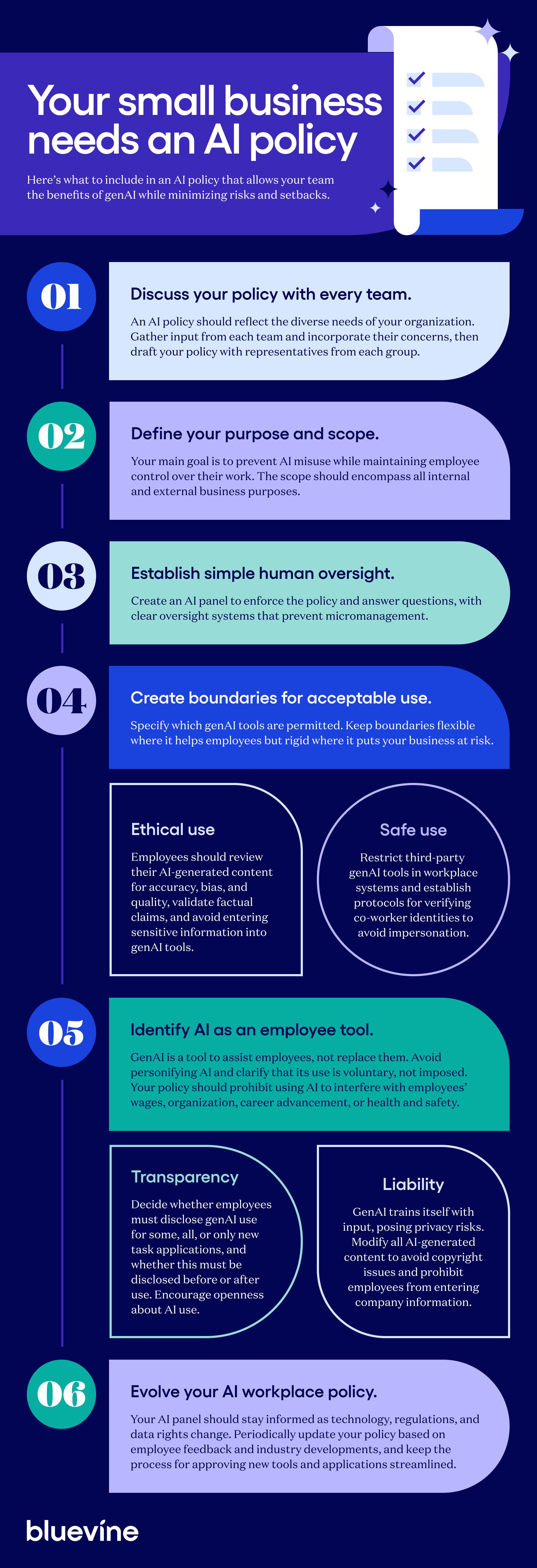
While AI is incredibly powerful, it’s not perfect. It’s crucial to maintain a “human in the loop” approach, especially in critical areas like customer communication or content creation. AI can generate drafts, provide insights, and automate tasks, but human oversight is essential for ensuring accuracy, maintaining brand voice, and adding that crucial element of empathy and creativity that only humans possess. Think of AI as augmenting human capabilities, not replacing them entirely.
As you integrate AI tools that handle customer data or sensitive business information, prioritize security and data privacy. Choose reputable providers that adhere to data protection regulations like GDPR. Understand how your data is being used and ensure it’s protected.
The field of AI is evolving at an incredible pace. What’s cutting-edge today might be commonplace tomorrow. As a small business, cultivating a mindset of continuous learning and adaptation will be key to maximizing the benefits of AI. Stay informed about new AI tools and trends, and be open to experimenting with new approaches.
The Future is AI-Powered, and Your Small Business Can Be Too
The idea of using AI might still sound a bit intimidating to some small business owners. But the reality is, AI is becoming increasingly accessible and user-friendly. It’s no longer just for the tech giants; it’s a powerful set of tools that can level the playing field, allowing small businesses to compete more effectively, operate more efficiently, and serve their customers better.
By strategically adopting AI, you can free up valuable time, make smarter decisions, deliver exceptional customer experiences, and ultimately, put your small business on a fast track to sustainable growth. The future is here, and it’s powered by AI. Are you ready to harness its potential and watch your small business truly flourish?